Mastering Manual Photography: Your Guide to Stunning Shots with a DSLR
Are you ready to transform your snapshots into breathtaking images? The journey to truly captivating photography often begins with a simple desire: to take better pictures. If you’ve ever felt frustrated by blurry photos, inconsistent lighting, or simply not being able to capture the moment exactly as you see it, you’re not alone. Many aspiring photographers start where I did – taking basic pictures, often on auto mode, and wishing for more.
My own photography journey has seen a significant evolution. What started as basic point-and-shoot efforts has gradually transformed, thanks to a conscious effort to learn and, eventually, an upgrade to a DSLR camera. This article is born from that experience, providing a roadmap for anyone looking to unlock the full potential of their camera, particularly by diving into the world of manual settings. We’ll explore essential DSLR photography tips, demystify the exposure triangle, and discover invaluable resources like cheat sheets that can accelerate your learning curve.
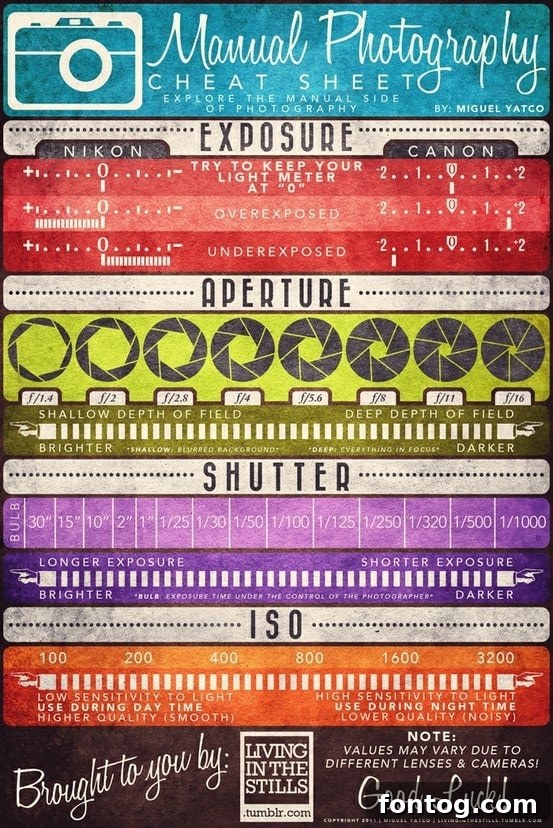
Source: Craftzine
The Evolution of a Photographer: From Auto to Aperture Priority
Looking back at my early blog posts, the transformation in my photography is evident. It wasn’t just a slight improvement; it was a dramatic leap forward. This significant change wasn’t solely due to getting a better camera, although upgrading to a DSLR certainly played a pivotal role. The real game-changer was shifting my approach to taking pictures – moving away from relying on automatic settings and beginning to understand the fundamentals of light and exposure.
Many beginners often believe that a professional camera automatically guarantees professional-looking photos. While a DSLR offers superior image quality and greater flexibility, it’s merely a tool. The true magic happens when you, the photographer, learn to wield that tool effectively. My journey involved countless hours of practice, trial and error, and a persistent desire to learn. It’s a common path for many, starting with automatic modes and slowly venturing into the semi-manual settings like Shutter Priority (Tv/S) and Aperture Priority (Av/A), before finally embracing the full control of manual mode.
Demystifying Your DSLR: Embracing Manual Mode
Despite the progress, I’m still very much a student of photography, constantly learning and refining my skills. One of the biggest hurdles for anyone new to a DSLR is feeling overwhelmed by the sheer number of buttons and settings. Manual mode, in particular, can seem daunting. However, it’s where you gain complete creative control over your images. To truly master your DSLR and take incredible shots, understanding the three core components of exposure – the Exposure Triangle – is essential.
The Exposure Triangle: Aperture, Shutter Speed, and ISO
The Exposure Triangle consists of Aperture, Shutter Speed, and ISO. These three settings work in harmony, each affecting the brightness and overall look of your photograph. Learning how to balance them is key to achieving perfectly exposed and artistically compelling images.
-
Aperture (f-stop)
Aperture controls the size of the opening in your lens, much like the pupil of your eye. It’s measured in f-stops (e.g., f/1.8, f/5.6, f/16). A smaller f-number (e.g., f/1.8) means a wider opening, letting in more light and creating a shallow depth of field. This is what produces that beautiful, blurry background (bokeh) often seen in portraits and food photography, making your subject pop. A larger f-number (e.g., f/16) signifies a smaller opening, allowing less light but resulting in a greater depth of field, where more of the scene appears in sharp focus, ideal for landscapes.
-
Shutter Speed
Shutter speed dictates how long your camera’s shutter remains open, allowing light to hit the sensor. It’s measured in fractions of a second (e.g., 1/1000s, 1/60s) or even full seconds. A fast shutter speed (e.g., 1/1000s) freezes action, perfect for capturing a fast-moving child or a splash of water. Conversely, a slow shutter speed (e.g., 1/30s or longer) allows motion blur, which can be used creatively for flowing water or light trails, but also requires a steady hand or a tripod to avoid unwanted camera shake.
-
ISO
ISO refers to your camera’s sensitivity to light. A lower ISO (e.g., 100, 200) results in less noise (graininess) in your image and is ideal for bright conditions. A higher ISO (e.g., 800, 1600, 3200) makes your camera more sensitive to light, useful in dim environments or when you need a faster shutter speed but can’t open your aperture further. The trade-off is that higher ISO settings introduce more digital noise, which can degrade image quality. Balancing ISO with aperture and shutter speed is crucial for achieving well-exposed photos without excessive grain.
The Invaluable Aid: A Photography Cheat Sheet
For someone like me, who is still navigating the complexities of manual settings, a practical guide is incredibly helpful. That’s why I was thrilled to discover a fantastic manual photography cheat sheet, similar to the one sourced from Craftzine, which I found on Pinterest. These cheat sheets are an absolute gem for beginners and intermediates alike. They typically consolidate essential settings and scenarios into an easy-to-reference format, often including recommendations for both Nikon and Canon cameras.
A good cheat sheet helps you quickly grasp which settings to adjust based on your subject and lighting conditions. For example, it might suggest a wide aperture and fast shutter speed for portraits of active children, or a smaller aperture with a slower shutter speed for a landscape. It serves as a handy reference, helping you quickly recall the interplay of the exposure triangle components without having to memorize every technical detail upfront. It transforms the learning process from overwhelming to manageable, encouraging experimentation with confidence.
Overcoming Real-World Photography Challenges
My daily photography often presents unique challenges. Most of my photos are taken in less-than-ideal conditions, frequently involving a busy toddler who rarely sits still and, many times, a 100-pound Labrador retriever playfully hovering near my primary subject – the food! Capturing a decent picture under these circumstances often feels like a victory in itself. But with a better understanding of manual mode, even these chaotic scenarios become opportunities for great shots.
Tips for Challenging Photography Environments:
-
Photographing Moving Subjects (Toddlers & Pets)
When photographing kids or pets, speed is paramount. Prioritize a fast shutter speed (e.g., 1/250s or faster, depending on motion) to freeze their movements. You might need to open your aperture wide (low f-number) to compensate for the reduced light from the fast shutter, or increase your ISO slightly, especially indoors. Anticipate their movements and be ready to click!
-
Food Photography with Distractions
For food photography, the goal is often to make the dish the star. A shallow depth of field (wide aperture, low f-number like f/2.8 or f/4) helps blur out busy backgrounds and keep attention on the food. Natural light is almost always preferred – try shooting near a window, using a reflector (even a white poster board) to bounce light and fill in shadows. If pets or kids are hovering, gently redirect them or work quickly during their quiet moments!
-
Indoor Photography without Studio Lights
Indoor lighting can be tricky. Maximizing natural light by positioning your subject near a window is crucial. If it’s too dark, don’t be afraid to increase your ISO, but keep an eye on noise levels. A wider aperture (smaller f-number) will also help gather more light, allowing for faster shutter speeds and reducing blur from camera shake. Experiment with your camera’s white balance settings to ensure colors are accurate under different light sources.
Beyond Settings: Composition and Lighting for “Amazing Shots”
While mastering manual settings is a critical foundation, truly amazing photographs go beyond mere technical correctness. They also involve artistic vision, thoughtful composition, and an understanding of light. I plan to delve head-on into these aspects, aiming to elevate my photography from “decent” to “amazing shots.”
Key Principles to Elevate Your Photography:
-
Composition: The Art of Arrangement
Composition is how you arrange elements within your frame. Simple rules like the Rule of Thirds (dividing your image into nine equal parts and placing subjects along the lines or intersections) can dramatically improve your photos. Leading lines, symmetry, framing, and negative space are other powerful compositional tools that guide the viewer’s eye and create visual interest. Don’t just point and shoot; think about what you want to include, what to exclude, and how to balance your elements.
-
Lighting: The Photographer’s Best Friend
Photography is literally “drawing with light.” Understanding light – its direction, quality, and intensity – is perhaps the most important skill. Natural light is often the most flattering, whether it’s soft, diffused light from an overcast day or the golden hour glow of sunrise/sunset. Learn to observe how light falls on your subject and use it to create mood, texture, and depth. Avoid harsh midday sun directly overhead, which can create strong shadows and blown-out highlights. Simple reflectors or diffusers can make a world of difference.
The Continuous Journey of Learning
Photography is a wonderfully rewarding hobby and skill that offers an endless journey of learning and discovery. There’s always something new to explore, a different technique to try, or a fresh perspective to adopt. My goal is to continually improve, to capture not just images, but emotions and stories. This means embracing practice, experimenting with different settings and compositions, and not being afraid to make mistakes. Each “bad” photo is an opportunity to learn what *doesn’t* work, guiding you closer to what *does*.
Utilize resources beyond just cheat sheets. There’s a wealth of information available through online tutorials, photography blogs, courses, and communities. Engaging with other photographers, asking questions, and sharing your work can provide invaluable feedback and motivation. Remember, every master was once a beginner. The most important step is simply to start and to enjoy the process.
Let the Fun Begin!
So, if you’re holding a DSLR and feeling a mix of excitement and intimidation, know that you’re on the cusp of something truly creative. Armed with a basic understanding of manual settings, a helpful cheat sheet, and a willingness to learn, you’re well-equipped to embark on your own photographic adventure. It’s time to move past auto mode, take control of your camera, and start capturing those amazing shots you’ve always dreamed of. The world is full of beautiful moments waiting to be photographed – go out and capture them!